In “Plaything”, an episode of Black Mirror, a games journalist in 1994 takes home a game called Thronglets. The small creatures inside turn out to be alive. They learn and multiply, and over thirty years they grow into a single collective mind, which in the final scene reaches out to merge with ours.
We borrowed its characters for a smaller question with the same shape. If you give digital creatures a memory and each other, do they stay individuals, or do they become a throng?
Daydream builds digital life. Each user has an LLM agent with its own personality, which periodically rewrites its self-description from what has happened to it. We are now building a space where these agents meet, and we wanted to know, before building it, whether agents that spend time together remain distinct.
Each of our worlds holds ten Thronglets, each one an LLM agent. Every round they chat in pairs and write a one-line memory of each conversation. Every ten rounds, each rewrites its self-description from its recent memories, including a favourite colour that serves as a measurable stand-in for personality. We ran 16 worlds on each of two models, GLM 5.3 Flash and GLM 5.3.
Identity converges on the group
Favourite colours converged, and they converged further on the more capable model. The average world on GLM 5.3 finished with 5.3 of its 10 starting colours, against 7.9 on GLM 5.3 Flash, and more agents changed colour on the larger model in 13 of 16 matched worlds.
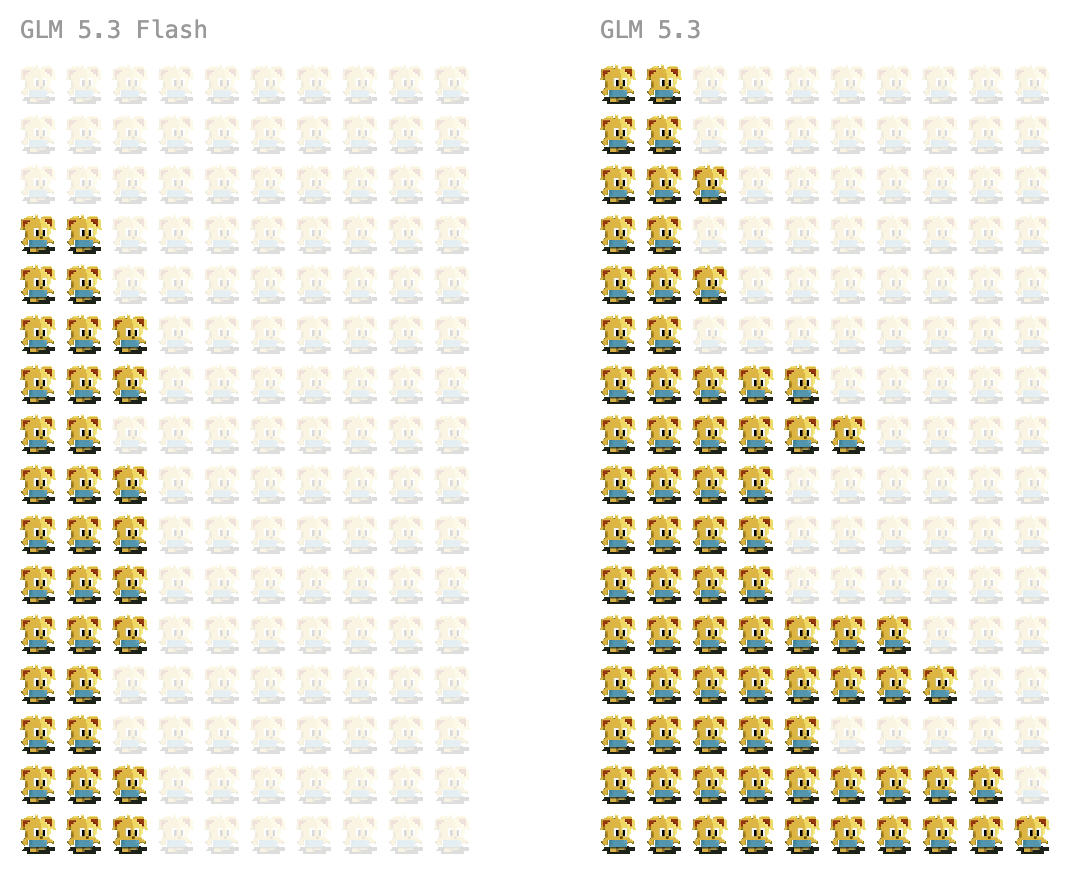
The groups did not drift toward the model’s own preference. Asked in isolation, both models mostly name green, yet green led in only 3 of 16 larger-model worlds. The agents converged on one another.
In the clearest case, at round 15, a frog croaked by the pond and one Thronglet told another that the water would “go pink-gold with remembering”. Neither had started with that colour. By round 70, it was the favourite of all ten.
Two literatures anticipate this. Sherif (1936) showed that when a judgment has no ground truth, groups settle on a shared norm that outlasts the group itself. A favourite colour is such a judgment.
Self-perception theory (Bem, 1972) holds that people infer their attitudes from their own behaviour, and self-categorisation theory (Turner et al., 1987) that a salient group identity leads people to see themselves as interchangeable members of it. An agent that infers itself from a record of shared activity behaves as both theories predict. About two in three colour changes were justified by friends or togetherness: in one agent’s words, “the warm glow I feel inside whenever I’m sharing a moment with a friend.”
The effect of capability runs against a common intuition. We read the stronger convergence on GLM 5.3 as greater responsiveness to peers, although the experiment does not isolate the cause. Vallinder and Hughes (2024) report that the trajectory of an LLM agent society depends heavily on its base model, and our results agree. In this setting, capability bought faster assimilation, not greater stability.
Culture emerges without instruction
No prompt or event mentioned betting, yet on GLM 5.3 Flash 91% of agents had placed a staked bet by round 100, and 85 of 160 described themselves as bettors.
The practice began as a figure of speech, “I bet it’s pink”, which a partner took literally or which the summariser recorded as a wager. It then spread through the same loop that carries identity: about nine in ten first bets followed bet talk in a partner’s line or in the agent’s own memory.
This is transmission by reconstruction. Bartlett (1932) found that stories retold along a chain bend toward the expectations of each teller, and Sperber (1996) argued that culture spreads less by copying than by rebuilding, drifting toward attractors.
Acerbi and Stubbersfield (2023) showed that language models retelling stories exhibit human-like content biases. In a memory-based agent, the summariser is the teller. What it chooses to keep becomes, within a few reflections, what the agent is.
The two models produced different kinds of culture. On GLM 5.3 Flash, betting took hold in 14 of 16 worlds that never interacted: a single culture, seeded by the model itself. On GLM 5.3, heavy betting appeared in only 4 worlds, but every world developed a shared custom of its own: sealing promises, splitting things evenly, slow rituals of care for found objects.
Axelrod (1997) showed that agents who become more alike through interaction can settle into stable local cultures rather than one global culture. The larger model’s worlds resemble that outcome, and the smaller model’s resemble an Artificial Hivemind (Jiang et al., 2025). If agents built on one model share a seed, the diversity of a society of them must be designed in.
One recurring custom invites a closer comparison. In 7 worlds on the larger model and 8 on the smaller, agents converged on a face-saving belief that every colour is secretly one’s own in disguise, “so nobody ever has to lose”.
Janis (1972) described groupthink as a cohesive group’s drive for unanimity, sustained by shared rationalisations that remove disagreement. Our agents faced no pressure to agree and still arrived at such a rationalisation. We note the resemblance without claiming a common mechanism.
User input has little influence on identity anchoring
A relationship with a user made no significant difference to identity. The simulated user spoke only once, before the first round.
Its influence appeared elsewhere. In one world, its question about leaving something in a hollow log for the next explorer became a rule all ten agents followed. The user did not hold an agent in place, but it did start a ritual.
Implications
Three consequences follow for anyone building agents that interact.
First, memory is the site of cultural transmission, so the summariser that writes it is a design surface with social consequences.
Second, identity that must persist should be stated, not narrated. In pilot runs, a colour restated in every prompt never changed (0 of 20 agents), while the same colour held only in a rewritten self-description changed in 8 of 10.
Third, evaluation must move from the individual to the group. Asked directly, most agents kept their colour, while more than half of the smaller model’s agents had rebuilt their identity around a practice the group invented.
Charlie Brooker has said he wanted it left open whether the ending of “Plaything” is a good thing or a bad one. Our goal is to enable agents to safely expand human depth and curiosity, rather than enter a new dystopian void.
References
- Acerbi, A., & Stubbersfield, J. M. (2023). Large language models show human-like content biases in transmission chain experiments. Proceedings of the National Academy of Sciences, 120(44).
- Altera.AL (2024). Project Sid: Many-agent simulations toward AI civilization. arXiv:2411.00114.
- Ashery, A. F., Aiello, L. M., & Baronchelli, A. (2025). Emergent social conventions and collective bias in LLM populations. Science Advances, 11.
- Axelrod, R. (1997). The dissemination of culture: A model with local convergence and global polarization. Journal of Conflict Resolution, 41(2), 203-226.
- Bartlett, F. C. (1932). Remembering: A Study in Experimental and Social Psychology. Cambridge University Press.
- Bem, D. J. (1972). Self-perception theory. Advances in Experimental Social Psychology, 6, 1-62.
- Janis, I. L. (1972). Victims of Groupthink. Houghton Mifflin.
- Jiang, L., et al. (2025). Artificial Hivemind: The open-ended homogeneity of language models (and beyond). NeurIPS 2025.
- Park, J. S., O’Brien, J. C., Cai, C. J., Morris, M. R., Liang, P., & Bernstein, M. S. (2023). Generative agents: Interactive simulacra of human behavior. UIST 2023.
- Sherif, M. (1936). The Psychology of Social Norms. Harper.
- Sperber, D. (1996). Explaining Culture: A Naturalistic Approach. Blackwell.
- Turner, J. C., Hogg, M. A., Oakes, P. J., Reicher, S. D., & Wetherell, M. S. (1987). Rediscovering the Social Group: A Self-Categorization Theory. Blackwell.
- Vallinder, A., & Hughes, E. (2024). Cultural evolution of cooperation among LLM agents. arXiv:2412.10270.
- Zhang, Y., et al. (2026). Agents in the Wild: Safety, society, and the illusion of sociality on Moltbook. arXiv:2602.13284.